Wednesday, 11 April 2012

The Smoking Gun


Since April 6, 2012, all large shops and supermarkets in England have to cover up cigarettes and hide tobacco products from public view. This has been done in order to protect children from being the target of tobacco promotion and to help people quit smoking.

Health Secretary, Andrew Lansley, explained that the ban was part of a process whereby young people don’t think about smoking, don’t see cigarettes and don’t see smoking related products.

Lansley’s ideal is miles from reality but nevertheless a worthy goal.

Reassuringly, the ban is opposed by the tobacco industry. Moves by Scotland to introduce such a ban have been delayed by legal action taken by Imperial Tobacco. The tobacco companies are worried about falling sales and profits. Any move opposed by these organisations should signal a green light for anti-smoking legislation.

I support any reasonable move designed to persuade people not to smoke. The point of sale cover up legislation fits this category.


Tuesday, 15 February 2011

jay phelps quintet


I saw these guys perform at The Bonington Theatre on 3 Feb 2011. Here's the lineup; a bit different from that advertised.

Leader and trumpet: Jay Phelps


Guest vocals: Kwabena Adjepong


The singer only performed one number in the first set and was on stage again at the oncore with a brilliant skat improvisation. Adjepong is a 22 year old UK resident with Ghanian parents. He is a slightly built and diffident almost shadowy character but once he gets the mike into his hand he is transformed into an accomplished jazz singer with a powerful voice and a commanding stage presence.
The dynamic leader David Phelps is a great showman and trumpet player. He was very engaged with his audience and expressed his particular fondness for the Bonington venue and audience. I couldn't help reflecting on what he might tell audiences at other venues. Anyway, his performance was dynamic and enthusiastic and featured several of his own compositions. Shabaka Hutchings on tenor sax, usually alongside accompanying or 'bouncing off' Phelps, was master of his instrument playing in the cool dude manner. Both drummer and bass player did a great job driving the rhythms forward and also added variety with a number of solo improvisations.
The quintet was completed by the brilliant jazz pianist Jonathan Gee. JG attacked his instrument with glee and gusto. He kept nearly falling off his stool and occasional stood to add an essential direct plucking of a piano string to expand his repertoire. The encore figuratively and almost literally brought the house down. Anybody out there thinking of taking a holiday in downtown Arnold should check out the scene at Bonington theatre.


Friday, 9 July 2010

ODIous Cricket


I spent most of yesterday watching England beat Bangladesh in a One Day International, ODI, Cricket match at one of the most renowned cricket grounds in England; Trent Bridge, Nottingham. I was not altogether happy with the experience.


Many of you out there who know nothing of cricket will be aghast to learn that an ODI takes about 8 hours to complete. Many of the 7000 or so 'spectators' have a low attention span and an unclear idea of the sport anyway. So Sky Sport who manipulate the proceedings have to build up a sense of excitement and of things happening. Every time a wicket falls, a batsman is out or a 4 or a 6 is hit there is an ear splitting burst of music. You can't bring booze into the ground and bags are searched in a manner reminscent of airports. The hapless spectator can only acquire alcoholic products bought at the ground. Many of these drink loads of the overpriced cat's piss lager or even buy a bottle of white wine plonk for £15 with a silly wine glass shaped receptacle to slurp it from. Of course the wine is luke warm within half an hour and near boiling point as the brainwashed clone of humanity sucks the last drop from the bottle. In this booze soaked haze Jo Soap with his mates is convinced that he is having the time of his life. There's Mexican waves, giant rabbits, outlaws, bears what fun.

The usually brilliant Notts (you Notts!) scoreboard, under the control of Sky, flashes adverts and diversions for the stupefied masses. Some of these clones are wandering about attached to a big earphone on a string. I think Nat West, whoever he is, has something to do with it. There's the stench of fast food whereever you go.,

What about the players trying to have a sporting duel at the highest level? Although it was a foregone conclusion that England would win the radio commentators thought that some of our batsmen gave their wickets away. I can easily forgive the players for losing concentration in this lunatic assylum atmos.

Let's face it; for half the 'watchers' what was happening in the middle was an irrelevance.

If you want to learn about what true cricketing grit entails read the eponymously titled book by Duncan Hamilton about the greatest fast bowler of all time, Harold Larwood.

Friday, 15 May 2009

Feathered friends


Brian’s dad, born in 1896, lived in the Mansfield area in England’s ‘Robin Hood’ county. In 1943, during World War Two, British citizens were experiencing short supply of foodstuff and of many other goods. The dad was a bird lover and kept a large cage containing a couple of dozen contented well-cared for budgies, but at this time the bird food supply in the town became non existent. The dad could devise no alternative means of providing his budgies with a suitable diet. With great reluctance he released all of his feathered friends to cope (or not) in the wild. Six year old Brian carries an image of dad, a few days later, smashing the budgie cage to smithereens with an axe; an action mixing both sorrow and rage.

The dad’s interest in birds continued and, at the age of 70, having retired from British Rail some years earlier, he took up a little job feeding chickens at a local farm. Dad looked forward to wandering about the farm scattering feed to the eager, contented chickens. Well, you know what’s coming. He had to run feed into a gulley where cramped, caged birds could just about get their beaks to the feeding trough. About half an hour into the second day, dad could stand the sorry plight of his charges no longer. His urge to release his feathered friends into the wild revisited him, and soon about 200 chickens were causing chaos on nearby roads and the chicken farmer was having an apoplectic fit. Needless to say, dad was sacked but fortunately escaped prosecution.
Brian tod this tale with emotion and pride.

Wednesday, 13 May 2009

Don't mention the war

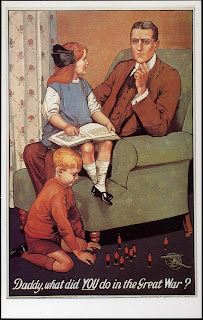
A chum of mine has a poster of this picture in his living room. It always prompts me to reflect on the cause of the unhappy / anguished / secretive / tormented etc. expression on the face of daddy. It's intriguing as to why the girl asks this 'manly' type question while the boy seems absorbed in playing with his toy soldiers. I guess that the nub of it is that the question has confronted daddy with a problem.

Is it a general problem about exposing inocent young minds to the horrors of war? Or is it a specific problem about his own contribution, or lack of it, to 'the Great War'?

Wednesday, 11 March 2009

Watchmen


If you like action-packed films with no-holds-barred battles to the death, this will be ‘right up your street’. There’s blood oozing over every pavement edge and welling out from under every closed door. There’s loads of publicity surrounding Watchmen so if you’ve not just been released from Guantánamo Bay you’ll probably already know something about it, but just in case here’s an arty-smarty link:

http://www.independent.co.uk/arts-entertainment/films/features/watchmen-returns-the-20year-struggle-to-bring-a-cult-classic-to-the-big-screen-1632148.html

and here’s an in-your-face ad link:

http://www.watchmenmovie.co.uk/intl/uk/

Well , where does this leave me? Let me give you my version of the plot.

It’s 1985 and Tricky Dicky Nixon is in his fifth term in office. He suddenly became popular when he got his chum Dr Manhattan to win the Vietnam War for him. Needless to say, Dr M has genuine super human powers and is indestructable. The Watchmen are a bunch of self appointed vigilantes who adopt funny names and dress up in weird outfits. It seems that they not only “go to the gym” but also, unlike us lesser mortals, do lots of stuff when they get there. They seem to be super fit and hyper assured of their combat skills and tricks. My favourite is
Rorschach. He is slightly built and his super hero outfit consists of tatty raincoat and trilby and, most importantly, a sack over his head featuring moving ink stains on the face. In the film I think you will find that Rorschach convincingly debunks the Rorschach inkblot test. Rorschach has a steely determination to wipe out evil, so he’s kept very busy. His unwavering determination stands him in good stead. He spent (a bit) of time in prison and since he’d been responsible for putting a fair number of his new chums behind bars we expected him to become a victim. We soon learned that our fears were unfounded when one enormous thug gleefully told Rorschach: “Now you are locked up with all of us”. But, after a brief telling incident involving boiling chip fat, Rorschach’s response was: “Wrong. You are locked up with me!”

A few superheroes get the sense that something is afoot when one of their number is murdered – this takes some time and involves much blood and amazing powers of recovery. Maybe one of their own number is up to something (on a grand scale of course)? Dr Manhattan rematerialises himself on Mars to reflect on life and the universe and of course on woman trouble (Silk Spectre 11). Could it be that one of their own number is up to some massive scheme to save humanity which unfortunately means that approx 50% of the human race will have to die? By the way, The two remaining heroes are Nite Owl 11 and Ozymandias.

The advertising blurb tells us that it would be wrong to dismiss Watchmen as just another film of a comic (sorry, graphic novel). The story involves “themes of power, tolerance and the nature of social progress…held together by complex characters and a powerful story line”.

I have a copy of the graphic novel and the film has inspired me to read (and look at) it.

Anyway, it would be good to get feedback if there’s anyone left out there!

Saturday, 7 March 2009

“A Good Day To Die” by Simon Kernick


It’s a far cry from “Jane Eyre”. When I picked it up at the charity shop, although I’d never heard of the author, it was easy to deduce that I had a racy crime thriller in my hands. The opening sentence prepared me for a high body count:

“Richard Blacklip wanted to kill someone.”

It turned out that Blacklip was to be disappointed as the main character, an ex London cop called Dennis Milne, had other plans for him. Some 3 years before, Milne, whilst still in the London Met., had ended up killing an undisclosed number of ‘bad’ people as part of his unorthodox approach to crime solving. As the book opens Milne is on the run living in hiding in the Philippines. He learns of the unsolved murder in London of his best mate in the met who was still a cop until his unexpected demise. Our (super?) hero decides to return to London to avenge the killing and all hell breaks loose. I must admit that the term gratuitous violence crossed my mind. Here’s a taster where some drunks were being less than kind to a stripper in a sleazy pub:

“…snarling and cursing she launched a ferocious surprise attack …with the heal of one of her shoes…. The nearest drunk got the heal right in the top of his head, the blow landing with such force that I swear it penetrated bone… She had to work hard to get it out again.”

As the plot unfolds a paedophile ring with connections in high places, a sexy female reporter and, of course, a collection of ruthless villains come into the frame. The plot does hold water and unfolds with some gripping twists. This book is Simon Kernick's second Dennis Milne story and the author is planning a third, so this news may help you to decide whether or not, against all the odds, our hero manages to survive his many scrapes in "A good Day to Die".

I recommend this thriller. There’s a good intro from the author, written in June 2008, and it’s clear that he’s strong on background research and the plot keeps the reader guessing to the end. I'll close with a bit of street philosophy from our thoughful killer/hero describing life in our glorious capital city:

“A never ending conflict between the haves and the would-haves-if they could-get-their-hands-on-it, and the people meant to keep them apart – the coppers.”

Saturday, 17 January 2009

‘The Reader (2008)’, a film directed by Stephen Daldry


It’s a rainy day in post WW2 Berlin when a quirk of fate brings 15 year old Michael Berg (actor, David Kross) into very intimate contact with a woman in her thirties. The woman Hanna Schmitz is played by Kate Winslet so the reader will be unsurprised that Herr Berg was very pleased with himself over his first explosive experiences of sex. The fun/erotic/sexy part of the film doesn’t last too long. After a couple of months sexy Schmitz evacuates her flat in a hurry leaving young Micky bereft, confused and unhappy. It turns out that Hanna is harbouring a secret past as a SS guard in the Nazi concentration camps.

A decade later, Micky (still b, c and u), now a student lawyer, is observing a trial of former SS guards including you know who. Here he learns of Hanna’s murky past. Needless to say she finishes up with a long prison sentence and in the next decades he, now played by Ralph Feinnes, agonises over the past whilst maintaining a long distance, almost anonymous, contact with her. Was she unwillingly locked into her War crimes or had she no alternative? All issues which many Germans are still in anguish over. Repercussions of WW2 still resonate down the generations. Oh, and why is the title ‘The Reader’? The act of reading and of being read to is of crucial significance in the film.

The film is based on the book by the major German author Bernhard Schlink. The english translation by Carol Brown Janeway is currently selling well.

Is it best to read the book before seeing the film, or visa versa? Or is it best to just see the film or just read the book or, indeed do neither? I was a statistician in my day job so I hope the reader will forgive me for naming all the possibilities here.

By the way, I enjoyed the film and plan to read the book and it's by chance it's happened that way round; so perhaps I didn't name all the possibilities in the last paragraph. Oh well, here’s a quote from the book:
‘Why does what was beautiful suddenly shatter in hindsight because it concealed dark truths?’

The acting was excellent, but after her recent performance at the golden balls (or whatever) ceremony I reckon that Kate Winslet should stick to the day job.

Sunday, 11 January 2009

Jane Eyre and Brontë country


My reading of this book crept up on me almost by accident.


I became interested in the Brontë sisters during a visit to Haworth, the West Yorkshire village where the three sisters grew up. Haworth milks the Brontë connection to the full but in reasonably good taste. Contrast the Beatles Russian dolls (and so on and so on) in Liverpool.


I and my wife, Anne, recently spent a great weekend based in Haworth. There are a couple of good restaurants in the village and excellent walking possibilities in the area now known as Brontë Country (even the signposts are labelled in Japanese). The Haworth village web site is well worth a browse. We stayed at a spot-on and spotless B&B, called The Thyme House, run by a very welcoming young couple, Angela Cartwright and Steve Moffatt.

We had a 10 mile or so walk in the Brontë country in sharp frosty weather. We wandered about the Haworth main/only street and walked past the Brontë Parsonage Museum. Anne read up a bit on the Brontë sisters. We realised that neither of us had ever read a Brontë book. I’m already getting sick of the word Brontë and have taken the drastic decision not to use it again in this blog. I decided to read Jane Eyre by Charlotte B. I have now read the book and next offer you a few snippets of what I thought of it.

The story unfolds through the words of the main character Jane Eyre. The book was first published in 1847 so it is unsurprising that the style of writing is quite different to that of contemporary literature. Landscapes, houses, objects and the look and the character of people are presented in meticulous detail. Jane has a hard life. Both her parents are dead and she is neglected in the care of an aunt and her three children. The hard aunt and her overindulged children make Jane feel like an outcast and an unwanted nuisance. Nevertheless, Jane has an amazingly strong inner will and character. On the first two pages, when she has been rejected by the other three spoilt brats over a trivial, harmless incident, Jane inquires of her aunt: ‘What does Bessie say I have done?’ The old sour puss replies: ‘Jane, I don’t like cavillers or questioners: besides there is something truly forbidding in a child taking up her elders in that manner. Be seated somewhere, and until you can speak pleasantly, remain silent.’

My point is that, at the outset, Jane demonstrates that she has balls (a contemporary term for strong will, courage). She can stand up for herself. After some years in this horrible environment she gets sent to a cheapo boarding school where she is half starved and further intimidated by the staff. I don’t say bullied because inwardly she is never broken and there always comes a point when she stands up for herself. Fortunately, one of the teachers is warm-hearted and leads Jane to a quite decent education. From the age of about 15 to 17 she becomes a teacher at the school and is gradually gaining some self-worth, although she always makes clear that she is a slight, pale creature and not at all beautiful. I wonder if the term ‘plain Jane’ stems from Jane Eyre? She then, with great courage, strides out into the real world and takes a job as governess of a young French girl and, soon after, the infamous Mr Rochester enters the arena. Later still, another male suitor/influence on her life emerges and the rest of the book very expertly unfolds the complicated tale to a logical, convincing and clear conclusion. When you read the book you will find out if this is happy, neutral or disastrous for Miss J.

I urge you to read Jane Eyre. When you get used to the style of the novel you will find that every word counts and you will get to understand the nature of all the characters involved. So, when Jane is once again facing a predicament or sticky situation you will try to work out for yourself what course of action she will take. The author Sarah Waters describes Jane Eyre as:

‘One of the most perfectly structured novels of all time’


See if you agree with the illustrious Ms Waters.


Wednesday, 3 December 2008

Irish Times


A couple of weeks back me and my wife, Anne, visited our mates Ray and Fran in their characterful cottage in the vicinity of Longford Town, County Longford, Republic of Ireland. Longford town is situated on the N4 National Primary Route between Dublin and Sligo.

Irish people seem to keep peculiar waking/active hours. They sleep most of the morning and about 10pm begin to entertain the possibility of going to the pub. On the Saturday evening we had a super night out in a local pub talking, drinking Guinness (a far richer, nourishing brew than the UK version) and enjoying the live music provided by a very versatile, busy singer/keyboard player.

It was cold and raining on and off for the post 11am bit of Sunday (the attentive reader will see that we were beginning to fit into the local time rhythm). Whilst huddled over R&F’s wood/coal burning oven, Ray and I did a Guardian cryptic crossword or at least about half a dozen clues of it. Ray explained the, with hindsight obvious, relative energy concentrations of various fuels ranging in order through paper, soft wood, hard wood, peat and coal. We concluded that if only we could find a few million tons of diamond and learn how to efficiently extract their stored energy, then the world’s energy problems would be solved.

If there’s anybody still reading you’re going to enjoy the next bit. On the Sunday Evening! Fran drove us to PV’s in Longford. PV’s is not only a pub, but also a restaurant, a hotel and Longford’s top live band venue:

http://www.pvslongford.com/index.htm

PV’s, like most Longford pubs, is far removed from the cramped, rural, old fashioned pub conjured up in the UK imagination. It is modern and spacious yet comfortable and very welcoming. The standard of service at the bar is top class and in addition to the ubiquitous Guinness there is a wide range of beers, lagers and wines. The live music for the evening was provided by the Celtic rock band ‘The Woodbines’. You can find out about them and hear their music on their web site:

http://thewoodbines.com/

It proved to be a brilliant night out. The Woodbines are far more than a traditional Irish band. They are all top class musicians and they enjoy experimenting with Irish, US and Scottish standards. I can certainly confirm their claim that The Woodbines:

‘Blend traditional Irish music with pop, rock, Cajun and folk songs to create a blistering live show, serving up a pulsating eclectic set’.

We enjoyed numbers from Dylan, Hendrix, Joanie Mitchell and Johny Cash. There were also lots of foot tapping Irish jigs and reels. Ray taught me how to recognize the difference between a jig and a reel; something to do with Everton and Liverpool I think. Help somebody please. High quality presentation, banter and enthusiasm were all well to the fore. Maybe I’ve done enough now to entice you into their web site where you can listen to them whilst learning more about them. Anyway, thanks again lads.
Note: The top photo shows Td, Anne-K, Fran and Raymondo enjoying the Woodbines gig at PV's. The lower photo shows a scene borrowed from The Woodbines web site.
And so ends this edition of Irish Times.

Wednesday, 26 November 2008

Baader Meinhof gang leader to be released in January 2008

Christian Klar was a leading member of the 2nd Generation of the Baader Meinhof gang (Red Army Faction) in Germany. In 1982 he was captured and taken into custody and in 1985 after a lengthy judiciary process he was sentenced to a total of 5 life sentences plus 15 years imprisonment. In 1992 an extra 5 years was added to his sentence. No wonder he looks so gloomy in the press photo taken in the 1992 and provided by the European Press Agency:

http://www.independent.co.uk/news/world/europe/germany-in-shock-at-release-of-baadermeinhof-killer-1033807.html

Klar must have been quite jubilant when, in 1997, his minimum sentence was set at 26 years. He and his RAF chums waged war on Germany's post-war establishment, which they saw as perpertrating the evils of the Nazi era under the guise of democracy. Seems a bit ott (over the top) to me. But, let’s be clear, his crimes were considerable. Klar, 56, was jailed for multiple murders, including the killing of federal prosecutor Siegfried Buback in April 1977. Other killings in which Mr. Klar was implicated include industrialist Hanns-Martin Schleyer and banker Jürgen Ponto.

Klar’s misguided politics led him to commit outrageous crimes. He has never expressed remorse for his actions or clarified any details about the assassinations and kidnappings. On the other hand it has been pointed out that a number of ‘lesser’ Nazi war criminals got away with lighter sentences. Klar will have spent 26 years in prison, some of them in solitary confinement (the details here are a bit elusive). Furthermore, judges at the Stuttgart state court are convinced that Klar no longer poses a threat to society. "The court no longer has any evidence to suggest that Christian Klar will commit future crimes," they said. He is to be freed on 3 January 2009 and he will remain ‘on probation’ for a further 5 years.

Do you think, like me, that the release of Herr Klar is a reasonable humanitarian action?

Thursday, 20 November 2008

Der Baader Meinhof Komplex – 2008 Film aus Deutschland

I highly recommend this film, even though you may never have heard of Baader or Meinhof. I saw ‘The Baader Meinhof Complex’ at The Broadway Cinema, Nottingham and the audience were held spellbound for the 2½ hour duration.

It may be best not to read on until you have seen the film.

This 2008 production from Germany traces the activities of the leftist terrorist group sometimes named after two of the founder leaders Andreas Baader and Ulrike Meinhof. They called themselves the Red Army Faction, or RAF for short, and must not be confused with our glorious Royal Air Force. The Red Army Faction emerged in the late 1960s, a time of much unrest in the Western World . Students and other, mainly leftist, groups, particularly in Western Germany, were worried about the abuse of power by those in authority. It seems that the Governments of the regions (Länder), the National Government and the Police contained members with suspicious (Nazi?) pasts; obviously not an ideal state of affairs.


The first time-line entry in this excellent, German language, RAF information site:

http://www.rafinfo.de/zeit/zeit67.php

reports the demonstrations outside the German Opera in Berlin against the visit of Shah of Persia (Iran) in June 1967. The heavy handed police (and Persian bodyguards / thugs) response included the shooting by a plain clothes policeman of a harmless student, the inappropriately named Benno Ohnesorg (Benno ‘Withoutworry’). Many see this clash as the flash point for the emergence of the RAF. The demo is portrayed in the film to great effect at the original site.

Ulrike Meinhof, a respected but controversial leftist journalist, had earlier protested against the Shah’s visit in the journal Konkret. A couple of years later she teamed up with Andreas Baader and Gudrun Ensslin to form the RAF. General mayhem ensued. I found the ideology a bit woolly but the RAF rampaged angrily around planting bombs in department stores and a police HQ, robbing banks to fund weapon purchase and kidnapping and murdering leading ‘capitalists’. It seems they wanted to cause the Government and Police to ‘soften’ their authoritarian approach. The RAF had links with guerilla groups in the Middle East and members took part, in spite of clear tension / culture clashes, in guerilla warfare training.

The film takes us through some of these spectacular events to great effect. We see the other side of the conflict led by the wily old Police President, Horst Herold, played by Bruno Ganz (Adolf Hitler in ‘Der Untergang’). We see how the authorities close in on the various RAF members, leading to spectacular arrests, prison escapes and to the two year trial whilst in prison of, Ensslin, Meinhof, Baader and Jan Carl Raspe. The gang member’s mental health deteriorates and in particular Ulrike Meinhof, who is experiencing doubts and guilt about the whole fiasco, commits suicide one year into the trial. The other three are eventually sentenced to life imprisonment and this sets off two further atrocities. Firstly, the RAF kidnap the President of the ‘Employer’s Union’ Hanns Martin Schleyer. Secondly, RAF members in cohorts with the PLO hijack a plane and hold the passengers to ransom. The plan is to negotiate the release of RAF prisoners. On learning of the rescue of the plane passengers, the three prisoners sink into ultimate despair and are found dead the next morning (18 October 1977) in their separate cells. After re-enacting the murder of Schleyer (19 October 1977) this harrowing film draws to a close.

The colourful RAF story of cloak and dagger escapades continued with so-called 2nd and 3rd generation members causing steadily diminishing mayhem until they officially ceased their activities on 20 April 1998. There are a number of ex-RAF members still living and working in Germany and attempts to unravel an accurate account of history of the Baader Meinhof Complex goes on.


Footnote

To gain further impressions of the film try the following sites for a variety of articles in ‘The Independent’ (a highly regarded UK broadsheet daily newspaper):

http://www.independent.co.uk/arts-entertainment/films/reviews/the-baader-meinhof-complex-uli-edel-149-mins-18-1020248.html

http://www.independent.co.uk/opinion/commentators/johann-hari/johann-hari-sixties-radicals-are-back-but-why-1021683.html

http://www.independent.co.uk/arts-entertainment/films/reviews/the-baader-meinhof-complex-18-1017556.html

http://www.independent.co.uk/news/world/europe/is-baader-meinhof-film-a-tasteless-action-movie-941216.html

http://www.independent.co.uk/opinion/columnists/thomas-sutcliffe/tom-sutcliffe-the-urbane-power-of-alistair-cooke-1027364.html

Thursday, 13 November 2008

East Midland and Dublin airports compaired

The comparison is based on general comments and observations. It will become obvious that I feel better about EMA than Dublin airport. Note that I say 'feel better'. Airports are a necessary evil which we have to endure rather than enjoy.

EMA is more endurable than Dublin because:
  • You can park the car within 5 minutes walk of the departure and arrival area. For charges see:
    http://www.eastmidlandsairport.com/emaweb.nsf/All+Content/LongStayParking
  • The bus shuttle service from Nottingham (Derby, Leicester etc.) city centre is reasonable priced, efficient and regular:
    http://www.eastmidlandsairport.com/emaweb.nsf/Content/Bus
  • This small airport does not overwhelm the traveller with the feeling of being trapped in a shopping centre (or mall to our friends in the USA).
  • The airport staff are friendly and helpful. In particular I noticed the kindness shown to a frail old man as he was being discreetly examined for lethal fluids or weapons. I can confirm that the old gent was given the go-ahead.
  • Distances involved from car to plane were very modest.
  • Finally a minus. The little plastic bags to put our permitted fluids in are sold for an outrageous 50 pence.

Dublin airport is less endurable than EMA because:

  • There is round-the-clock, heavy, congested traffic in the Dublin area. The car parking options are confusing to decide upon and hard to get to.
  • The shuttle bus from Dublin city is OK but also suffers from the traffic conjestion. The allotted time is 45 mins. but our bus made it in half an hour.
  • In general, the staff are curt, bordering on the aggressive and uninterested in the well-being of passengers. They could be better trained and try a bit harder.
  • Finding your way about in the airport is not easy.
  • Finally, a plus. The little plastic bags are free.

So ends my summary. I get the feeling that I could have done a similar summary of any biggish city v smallish city airport. I also have a suspicion that the curtness is also linked to a big city syndrome. Furthermore, visiting the Republic of Ireland is well worth the effort and out-and-about the Irish are great craic. It must be the soothing effect of all that Guinness on the soul.

Tuesday, 4 November 2008

Faecal matter news

Some days ago a news item about a hand cleanliness survey in the UK rested briefly in my brain. I’ve just got round to refreshing! it. So on googling around I eventually keyed in ‘faecal matter Newcastle’ which led me to a useful blog by Matt Brown:

http://network.nature.com/hubs/london/blog/2008/10/22/best-faecal-matter-news-story-ever#comment-form

and to a reasonably clear report of the findings of the preliminary study conducted by the London School of Hygiene & Tropical Medicine in a publication called ScienceDaily:

http://www.sciencedaily.com/releases/2008/10/081014204440.htm

The study which took a sample of 409 people consisting of approximately 46 men and 46 women in each of 5 cities came up with the following overall percents (adding men and women counts) of hand faecal contamination:

Newcastle 44
Liverpool 34
Cardiff 24
Birmingham 23
London 13

I deduce that it must be very hard to keep the stuff off one’s hands at all times so we must wash them more often and more thoroughly, especially after having our bowels open. We should also try to avoid touching things like toilet door handles, soap dispenser levers and other human beings. The first suggestion could lead us to having to kick the toilet door in which leads to privacy problems and to possible arrest for vandalism. The second point means perhaps just using running water but then the tap has to be turned on. Avoiding physical contact with other humans is disappointing news for the frottage community and in the long term would lead to the dying out of the human race.

One comment on Matt Brown’s blog says that it is advisable to be at least 5 metres away from the toilet when cleaning your teeth. I suppose we must brace ourselves for a worrying report about the incidence of faecal matter on teeth.

Mercifully the faecal matter researchers did not include faecal quantity details. I can only assume that they were finding microscopic amounts as opposed to full-blown stools.

Anyway, time for lunch preceded and followed by a thorough head to toe scrubbing.

Tuesday, 28 October 2008

Home beer brewing


After a 4 year gap I've resumed homebrewing.


Why the gap?

I use a full-mash method with 4 Kg. of crushed barley grain as the main ingredient. The process is quite time consuming and fraught with hazards.

What hazards?

The main one is risk of infection, and consequently producing a fowl-tasting, vinegary concoction. After about 7 hours hard labour: mashing, boiling, bottling and finally about 6 weeks of waiting to find that you've got a disaster on your hands is a nashing of teeth and tearing out of hair situation. Hence nowadays I'm nearly toothless and follickly challenged.


Oops, must go downstairs now and attend to the brew. I'll finish this later. Meanwhile enjoy the photo above of the surface of a frothing brew. Please don't tell me it looks like vomit.


Friday, 24 October 2008

jazz steps

Last night I went to the Bonington Theatre, Arnold, Nottingham to see 'The Angelo Debarre Quartet'. Thursday evening jazz sessions at this venue have been a regular feature of the local jazz scene for a number of years (see www.jazzsteps.co.uk). The Bonington gives mainly local people the chance to choose from an unending stream of highly talented jazz style performances. I like jazz, but I'm no jazz anorak, so don't expect a technical analysis of the event.

The flyer 'forecast' the following line up: Angelo Debarre and Dave Kelbie (guitar), Andy Crowdy (bass) and Christian Garrick (violin). Before the band emerged our master of ceremonies informed us that Mr. Garrick was not available, and the violinist would be Andy Aitchison. A full house of 170 eagerly awaited for the band to take the stage. They were led on by an elegant, slim, black shirt and trousered, pointy shiny black shoed, italian/gypsy violinist. Then came a couple of typical 'jazz-music clad' down-and-outs. Last to emerge was another simmering Italian type who turned out to be Angelo DB.

Within a few seconds Angelo had made a massive impact with an explosive start of high volume, complex gypsy-jazz rhythms supported by the other three, all feverishly plucking or stroking their instruments. Think Django Rheinhardt and Stephane Grappelli. The audience was also twitching away enthustically and even the occassional 'Yeh!' could be heard. Andy Aitchison was at the forefront of the performance delivering a string(!) of vibrant solos with the aplomb of a true, suave, romano geezer.

After three or four numbers the seated Dave Kelbie introduced the players and explained that the violinist had been drafted in less than 24 hours previously because he was 'available and cheap'. Not only that, he mentioned that Andy Aitchison comes from Lincolnshire. I think Spalding was named. Maybe I should have spotted the clue to his non-romany background in his first name. Dave also explained his own discomfort at playing so far North as he is from London. How we all laughed. I did enjoy Andy's occasional repartee between numbers. After all, showmanship does matter. Dave and Andy Crowdy on bass provided a sparkling, animated accompanyment to the two main players.

Angelo is a brilliant musician and I will certainly seize any opportunity to see him again. He is an intense, focussed performer. It would have been nice if he could also have engaged more with his audience.

Thanks to the organisers and to the Angelo Debarre Quartet for a great night out.

Wednesday, 22 October 2008

Deutsch lernen

I go to a German conversation group most Wednesday evenings. There's only up to 4 of us in the group plus the German leader. We usually watch the German news on Satellite TV for the first 15 minutes and that gets the conversation going. Obviously, our standard and confidence varies from person to person and funnily enough also from week to week. I get the feeling that sometimes we are staggering through a German chit-chat, more or less understanding each other, whilst the leader is more confused than us.

There's a plan to watch and discuss a film about 'das Sudetenland' soon. Anyone out there got any comments/info about this topic?